MAKE-OVER MODE...

This site is currently undergoing changes. Please do visit from time to time. Thanks!
Showing posts with label Health and Wellness. Show all posts

Friday, July 30, 2010

Chicken? Oh, No! It’s SOYa!


Yes, peeps...scientists at University of Missouri have created a soy substitute that doesn’t only look like chicken but also feel and taste like chicken.   Fu-Hung Hsieh, a University of Missouri professor of biological engineering and food science in the College of Agriculture, Food and Natural Resources and the College of Engineering, is the leader of the project to create a low-cost soy substitute for chicken. According to Hsieh "early tests provided some of the fibrous texture to the final product, but it tasted more like turkey.   In order to produce a more realistic product, we had to tweak the process and add extra fiber to give the soy a stringy feeling that tears into irregular, coarse fibers similar to chicken."
  
Other meat alternatives like soy burger became popular in USA, that it triggered an increase in sales volume of eight percent (8%) for 2007 and 2008.

Soy chicken was created by Hsieh from a soy protein extracted from soy flour.   Health wise, consumers will benefit from soy chicken as soy foods contain important nutrition components, some of which help maintain healthy bones and prevent prostate, breast and colorectal cancers. It is also a good source of essential fatty acids and contains no cholesterol.

Hsieh's research has been published in the Journal of Food and Agricultural Chemistry, Journal of Food Science, and Journal of the American Oil Chemists' Society.


Source Info:

University of Missouri-Columbia (2010, February 5). It looks, feels and tastes like chicken, but it's made of soy. ScienceDaily. Retrieved June 8, 2010, from http://www.sciencedaily.com­ /releases/2010/02/100204144549.htm


Image Source:  
pmd23
weazel05 

Saturday, January 16, 2010

Apple Juice May Delay Key Aspects of Alzheimer's Disease


Most recent study shows that regular consumption of apple juice can help to delay symptoms of age related cognitive decline according to report published in Journal of Alzheimer's Disease.  Dr. Shea said that " these findings provide further evidence linking nutritional and genetic risk factors for age-related neurodegeneration and suggest that regular consumption of apple juice can not only help to keep one's mind functioning at its best, but may also be able to delay key aspects of Alzheimer's disease and augment therapeutic approaches."

Thomas B Shea, PhD of the Center for Cellular Neurobiology; Neurodegeneration Research University of Masachusetts, Lowell and his research team demonstrated by giving the human equivalent of 2 glasses of apple juice to the mice for one month and found out that it produced less of a small protein fragment, called "beta-amyloid" that is responsible for forming the "senile plaques" that are commonly found in brains of individuals suffering from Alzheimer's disease.


Source info:
IOS Press (2009, January 24). Apple Juice Can Delay Onset Of Alzheimer's Disease, Study Suggests. ScienceDaily. Retrieved January 16, 2010, from http://www.sciencedaily.com/releases/2009/01/090122100826.htm

Image source:
christynstuff05
emily_vaughan


Thursday, December 17, 2009

Malunggay: May Help Men With Low Sperm Count


One of the many vegetables that I really respect and love is Malunggay (scientific name: Moringa Oleifera). Regarded as a "miracle tree" by research scientists and nutritionists, it boasts numerous medicinal and health benefits. The tree can thrive on up to 48 degrees centigrade temperature but it is said to be best suited for 15-35 degrees environment. It's easy to grow and doesn't require too much tending and care. We have two malunggay trees now in our backyard courtesy of my mother.

Per analysis, the dark green oval-shaped leaves contain more Vitamin A than carrots, more calcium than milk, more iron than spinach, more Vitamin C than oranges, and more potassium than bananas and that the protein quality of Moringa leaves rivals that of milk and eggs. Most breastfeeding mothers here in the Philippines are advised to eat malunggay to produce more milk for her baby.

On the medicinal benefits, malunggay is known long before for its antibiotic and antifungal properties. However, claims on this note needs to be supported with placebo controlled, randomized clinical trials. Although scientific evidences were available for over 50 years, much of these are completely unknown to western scientists. Also, recent pronouncement from Bureau of Plants Industry says that eating malunggay helps to increase the sperm count of men. Aw, men, this must be a very welcome news for all of you out there who has problem with numbers down there.

Aside from being eyed as a solution to hunger and chronic malnutrition to impoverished areas here in the Philippines, it is also being considered as a potential source of biofuel. The seed of malunggay is said to be 36% oil. According to Engr. Manayaga, President and CEO of Secura International Corp., a local biotechnology company, they need at least 20,000 hectares to support the available market for malunggay products like food fortification, animal feeds, cosmetics, edible oil and water treatment among others. The market is there, but sad to say, there is no sustainable supply to go with it. Secura will buy the seeds of malunggay from the growers at a farmgate prize of P10 per kilo for the production of moringa oil. For this, they need around 500,000 hectares of malunggay trees.   Further, Secura earlier declared that it is keen on forging supply contracts with farmers planting malunggay.

There! A shoutout to those who have idle lands for possible earning big sum of money.


Source info:

http://www.tfljournal.org/article.php/20051201124931586  written by Jed W. Fahey, Sc.D.
http://www.pia.gov.ph/?m=12&fi=p080401.htm&no=26 written by Rizalie A. Calibo

Tuesday, December 1, 2009

Delicious Red Apple


Who wouldn't love seeing a red delicious apple and enjoying eating it?   But, how do you like your apple?   Are you the type that loves to dig your white teeth to that beautiful red skin of an apple?   Or, are you the one who wants it all clean and peeled and ready to munch?   Well dear, think again.   Latest info based on a new Cornell study says that they have identified a dozen compounds - triterpenoids in apple peel that inhibit or kill cancer cells in laboratory cultures.   This triterpenoids may be doing much work by not only fighting cancer cells but also by reducing the number and size of mammary tumors in rats.  The analysis is from the 230 pounds peel of red delicious apples from Cornell Orchard by Rui Hai Liu, associate professor of food science and co-author Xiangjiu He, Cornell postdoctoral researcher.   They've isolated the apple peel's individual compounds and identified their structures.   Afterwards, they've tested the pure compounds against the cancel cell growth in the laboratory.   Previously, Liu has also identified compounds called phytochemicals such as flavonoids and phenolic acids in apples and other foods that seem to  have anti-cancer properties as well, including inhibiting tumor growth in human breast cancer cells.

So, when you eat that delicious red apple, always remember this:  an apple peel a day might help keep cancer at bay.


Image source:
PicassoDaVinci

Source info:
Cornell University (2007, June 3). An Apple Peel A Day Might Keep Cancer At Bay. ScienceDaily. Retrieved December 1, 2009, from http://www.sciencedaily.com /releases/2007/06/070601181005.htm

Friday, October 16, 2009

Red Juicy Strawberries


Among the berries family, I am more familiar with the delicious taste of red strawberries.   Maybe because it is available and being grown in La Trinidad, Benguet here in the Philippines.   I remember way back in 2005 when La Trinidad baked the Strawberry Butter Cake.   The Guiness World Book of Records confirmed it and declared it as the largest fruit shortcake in 2007.  It was shaped as a giant strawberry, weigh 9,600 kilos, 8 feet high and 12 feet long x 9 feet wide.   Most importantly, fed 42,080 people.   Beat that!

 Aside from eating strawberries fresh, it is also made into yummy strawberry jam just like what you can buy when you go up to Baguio City.   And oh! I also love it as flavors in ice creams, shakes and yogurts.  Opps, love those pies, too!

Just what do we get for eating that sweet red fruit?   It's a fact that strawberries are high in vitamins and minerals like B2, B5, B6, Vitamin K, copper and magnesium.   The fiber content in this little sweet fruit helps the body absorb nutrients, helps stabilize the blood glucose and inhibits the production of cholesterol in liver.  The potassium content will help regulate the electrolytes in the body and lowers the risk of heart attack and stroke.   It is also high in folate, a key ingredient in the manufacture of red blood cells.   The high antioxidant level in the strawberries can help neutralize the destructive effects of free radicals in our system and help repair our body tissues.

So next time you bite that red juicy fruit, smile and savor the taste because those strawberries gives you a lot of health benefits.

Image source:

Saturday, September 19, 2009

I Love Mango!


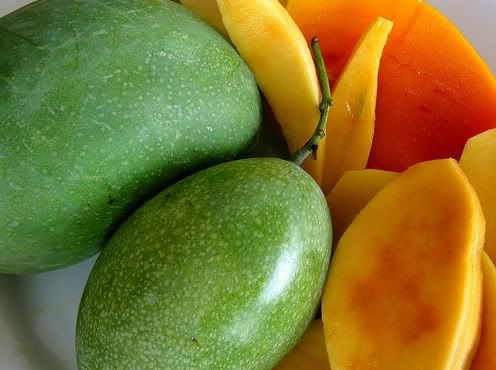
Yes! Mango has and will always be a favorite fruit of mine.   I love the sweet and fragrant smell of the ripe ones.   I can really devour several pieces of that golden yellow, heart-shaped fruit especially when I was younger.   Pity I am diabetic now that's why I slowed down eating this lovely fruit because it is classified as Medium in the Glycemic Index of Food.   Glycemic Index as Wikipedia defined is a measure of effects of carbohydrates on blood sugar levels.   I remember way back then during my 5th grade when our family relocated from Manila to Laguna. Me and my friends had the joy of climbing the mango trees and picked the mangoes we like and eat them there and then.  They have 3 varieties: Kalabaw, Piko and Indian.

Mango is rich in anti-oxidant - vitamins A and C.   Vitamin C is more pronounced in unripe or green mangoes.   It also has traces of vitamins E, B and K.

Mangoes are also used for culinary purposes.   They are used for sauces, cakes, preserved like jams and pickles, jellies, shakes, sorbets and ice creams.  Locally, we see dried mangoes on the shelves of the supermakets and some brands are already being exported to other countries.  Philippines is one of the major exporters of mangoes in the world.

Here is one of the refreshing mango drink developed by the Food and Nutrition Research Institute-DOST at their website written by Ma. Idelia G. Glorioso, NCS, RUMD:

Mango Medley


Ingredients:
  1. 1 piece ripe mango
  2. 1 piece banana - lakatan
  3. 1 slice papaya
  4. calamansi juice (lemon)
  5. sugar to taste
Procedure:
  1. Blenderize the fruits until smooth.
  2. For every 1/3 cup of fruit pulp, add 2/3 water.
  3. Stir in calamansi juice and sugar.
  4. Chill.
It makes 4 servings.   Enjoy this healthful drink!

Image source:
rickguatzjr

Wednesday, August 19, 2009

Black Tea for Diabetes?


This would certainly be good news for diabetics: black tea for controlling diabetes, according to the latest study in the Journal of Food Science, published by the Institute of Food Technologists.   Researchers from Tianjin Key Laboratory in China studied the Polysaccharide levels of oolong, green and black teas and found out the possibility for usage in the treatment of diabetes.

Of the three teas tested, the black teas contain the most glucose-inhibiting properties of polysaccharides. Polysaccharides are the complex carbohydrates which is made up of sugars and starches and may prove to be beneficial to people with diabetes because it helps slow down the absorption of glucose. It also showed the highest scavenging effect on free radicals that act on the onset of diseases like cancer and rheumatoid arthritis. Black teas have also been known for its antioxidants, immune boosting and most recently, antihypertensive properties.

News Source:
Institute of Food Technologists (2009, August 13). Black Tea May Fight Diabetes. ScienceDaily. Retrieved August 19, 2009, from http://www.sciencedaily.com /releases/2009/07/090728172604.htm

Image source:
sarahspo
kingofyuntea

Twitter Delicious Facebook Digg Stumbleupon Favorites More

 
Design by Free WordPress Themes | Bloggerized by Lasantha - Premium Blogger Themes | Facebook Themes