MAKE-OVER MODE...

This site is currently undergoing changes. Please do visit from time to time. Thanks!
Showing posts with label Vegetables and Root Crops. Show all posts

Saturday, January 9, 2010

Lumpiang Ubod (Fresh Spring Roll - Palm Heart)

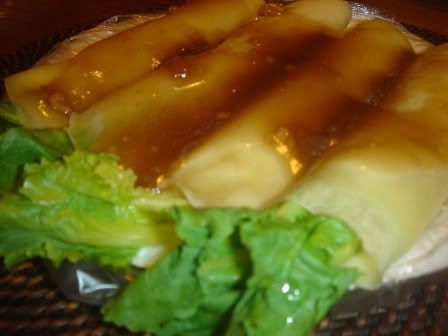
If you love vegetables with a little meat in it, then Lumpiang Ubod (Fresh Spring Roll - Palm Heart) is for you. With all those fried meat and fatty foods that we had during the holiday season, let's have a healthy one at the table this time.   Here it is:


Ingredients:
  1. 2 teaspoon cooking oil
  2. 1 medium sized onion, chopped
  3. 1 teaspoon garlic, minced
  4. 1 cup chicken meat, shredded
  5. 1/2 cup shrimp, devained (optional)
  6. 2 cups ubod (palm heart), julienned
  7. 1 teaspoon black pepper, ground
  8. 2 teaspoons salt (or patis/fish seasoning) 
  9. balat ng lumpia (spring roll/egg roll wrappers)
  10. lettuce leaves
     For the sauce:
  1. 1 cup brown sugar
  2. 3 teaspoons soy sauce
  3. 2 1/2 cups water
  4. 1  teaspoon salt
  5. 3 tablespoons cornstarch (dissolved in 1/2 cup water)
  6. 3 tablespoons crushed peanuts (or crunchy peanut butter)
  7. black pepper, ground (to taste)
Cooking Procedure:
  1. Pour the cooking oil in a medium heat pan.
  2. Saute the garlic and onion.
  3. Add the shredded chicken and stir until golden brown.
  4. Season with salt (or patis/fish seasoning)
  5. Add shrimp and saute for 2 minutes.
  6. Add the ubod and stir occassionally until it is tender.
  7. Set aside to cool down before wrapping it.
     For the sauce: 
  1. In a pot, mix the sugar, soy sauce, water, salt, crushed peanut (crunchy peanut butter) and bring to a boil.
  2. Add the cornstarch mixture.
  3. Stir constantly until it thickens.
  4. Season with ground black pepper to taste.
In a tray or big plate, lay one piece of egg roll wrapper.   Place one lettuce leaf at the left of center of the wrapper.   Place 2 tablespoons of the sauted vegetable in the middle of the lettuce leaves.   Take the lower portion of the wrapper and join it at the top portion of the wrapper giving a half circle appearance.   Fold the right side towards the middle and roll it.   Serve with sauce.

I hope you love it... enjoy!

Image source:

Thursday, December 17, 2009

Malunggay: May Help Men With Low Sperm Count


One of the many vegetables that I really respect and love is Malunggay (scientific name: Moringa Oleifera). Regarded as a "miracle tree" by research scientists and nutritionists, it boasts numerous medicinal and health benefits. The tree can thrive on up to 48 degrees centigrade temperature but it is said to be best suited for 15-35 degrees environment. It's easy to grow and doesn't require too much tending and care. We have two malunggay trees now in our backyard courtesy of my mother.

Per analysis, the dark green oval-shaped leaves contain more Vitamin A than carrots, more calcium than milk, more iron than spinach, more Vitamin C than oranges, and more potassium than bananas and that the protein quality of Moringa leaves rivals that of milk and eggs. Most breastfeeding mothers here in the Philippines are advised to eat malunggay to produce more milk for her baby.

On the medicinal benefits, malunggay is known long before for its antibiotic and antifungal properties. However, claims on this note needs to be supported with placebo controlled, randomized clinical trials. Although scientific evidences were available for over 50 years, much of these are completely unknown to western scientists. Also, recent pronouncement from Bureau of Plants Industry says that eating malunggay helps to increase the sperm count of men. Aw, men, this must be a very welcome news for all of you out there who has problem with numbers down there.

Aside from being eyed as a solution to hunger and chronic malnutrition to impoverished areas here in the Philippines, it is also being considered as a potential source of biofuel. The seed of malunggay is said to be 36% oil. According to Engr. Manayaga, President and CEO of Secura International Corp., a local biotechnology company, they need at least 20,000 hectares to support the available market for malunggay products like food fortification, animal feeds, cosmetics, edible oil and water treatment among others. The market is there, but sad to say, there is no sustainable supply to go with it. Secura will buy the seeds of malunggay from the growers at a farmgate prize of P10 per kilo for the production of moringa oil. For this, they need around 500,000 hectares of malunggay trees.   Further, Secura earlier declared that it is keen on forging supply contracts with farmers planting malunggay.

There! A shoutout to those who have idle lands for possible earning big sum of money.


Source info:

http://www.tfljournal.org/article.php/20051201124931586  written by Jed W. Fahey, Sc.D.
http://www.pia.gov.ph/?m=12&fi=p080401.htm&no=26 written by Rizalie A. Calibo

Monday, August 31, 2009

Laing (Taro Leaves in Coconut Milk)


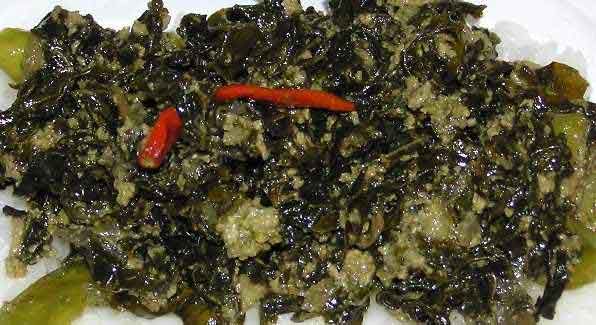
Laing is one of Bicol's well-known and sumptuous dish among the locals.   Bicolanos' version of Laing is very spicy and you can tell by the presence of several pieces of cayenne peppers (siling labuyo) in the dish.
Ingredients:
  1. 1 pack 70 grams shredded dried gabi (taro) leaves
  2. 1 cup coconut cream (kakang-gata)
  3. 2 cups coconut milk
  4. 1/2 cup shredded dried bakalaw meat or (codfish meat)
  5. 1 thumb-size fresh ginger
  6. 1 small minced onion
  7. 5 cloves minced garlic
  8. 2-3 pieces cayenne pepper (siling labuyo)
  9. salt to taste
Cooking Procedure:
  1. Put the saucepan in medium heat.
  2. Add the coconut milk and let it simmer.
  3. Add ginger, garlic and onion.   Simmer for 2 minutes.   Stir constantly to avoid curding.
  4. Add fish.  Simmer until fish is nearly cooked.
  5. Add taro leaves.   Stir to make sure the coconut milk is absorbed by the taro leaves.
  6. Cover and let it simmer for 5 minutes.
  7. Add the coconut cream (kakang-gata).
  8. Let it simmer again until the coconut cream is absorbed by the taro leaves.
  9. Add the cayenne peppers (siling labuyo).
  10. Cook until the leaves are soft but not soggy.
  11. Season with salt according to taste.
Image Source:
astoderalf

Saturday, August 22, 2009

Ukoy or Okoy (Shrimp Fried Patties)


I felt an instant craving for ukoy or okoy (shrimp fried patties) as others would call it.   It was raining yesterday afternoon when the thought of that food came to mind.      As far as I remember, none sells this to nearby eateries.   I waited for the rain to stop and went to the nearest wet market to buy the items I need.   Luckily, I got the basic ingredients to make them.   So, here it goes.

Ingredients:
  1. 1/4 kilo mongo spouts or toge
  2. 1/4 kilo shrimp or small prawns ( shelled)
  3. 1 onion sliced
  4. 1/2 stalk shallots or some stalks of onion leaves
  5. 1/2 cup cornstarch
  6. 1/4 cup water
  7. 1 egg
  8. 1 small square block of tofu or tokwa (optional)
  9. 1/2 teaspoon of salt
  10. 1 cup cooking oil for frying
  11. 4 tablespoon vinegar
  12. 1 tablespoon soy sauce
  13. 3 cloves chopped garlic
  14. 1 piece chopped fresh cayenne or bird pepper (siling labuyo)
Cooking Procedure:
  1. Beat the egg in a deep bowl.
  2. Mix the cornstarch, salt and water.
  3. Then add the mongo sprouts (toge), onion, shallots and tofu and mix well.
  4. Heat a deep frying pan and pour the cooking oil.
  5. When the pan is already hot, place the mixture (about 3 1/2 inch in diameter and 1/2 inch thick).
  6. Flatten and topped with 2-3 pieces of shrimp.
  7. Cook both sides until golden brown.
Dipping Sauce:
Mix the vinegar, soy sauce, chopped red chili and garlic.   Adjust accordingly depending on your taste.
Have fun cooking Ukoy or okoy as much as I had.  Enjoy and happy eating!

Friday, August 21, 2009

Kamoteng-kahoy (Cassava Cake)


Cassava cake or kamoteng-kahoy in Tagalog has long been a favorite of Filipinos during snack time or as a dessert.

Ingredients:

1. 2 cups grated cassava
2. 1 1/2 cup coconut cream
3. 2 beaten eggs
4. 1/2 cup pineapple juice
5. 1 cup condensed milk
6. 1 cup macapuno strings (optional)
7. 1/2 cup condensed milk (for topping)
8. 1 1/2 cup grated cheese (for topping)

Cooking Procedure:

1. Mix cassava, coconut milk, eggs, pineapple juice, milk and macapuno strings in a big bowl.
2. Transfer the mixture in a square pan.
3. Bake it at 350 degrees Fahrenheit oven for 45 minutes.
4. Add 1/2 cup condensed milk on top.
5. Sprinkle the grated cheese on top.
6. Bake for another 5-10 minutes or until the top is golden brown.

Enjoy this delicious cassava cake!

Ginataang Ampalaya (Bitter Melon with Coconut Milk)


Ampalaya or Bitter melon has long been known to be a nutritious vegetable and a good source of iron. So, if you are diabetic, bitter melon is good to include in your regular diet because it is a good supplement in maintaining your normal sugar level. Here is the procedure for cooking Ginataang Ampalaya (Bitter Melon in Coconut Milk).

Ingredients:

1. 4 medium sized ampalaya (bitter melon) sliced 1/2 inch thick diagonally
2. 1 cup coconut milk
3. 1 cup coconut cream
4. 200 grams diced pork (dried fish or dried shrimp can be used instead)
5. 2 pcs green finger pepper (siling berde pangsigang)
6. 1 medium sized onion
7. 2 cloves of garlic
8. 1/2 inch crushed ginger
9. 2 tablespoon shrimp paste
10. 2 pcs. cayenne or bird pepper if you want it spicy (siling labuyo) cut in half (optional)
a pinch of salt to taste

Cooking procedure:
1. Put the frying pan in a medium heat. Tenderize the pork in a small amount of water.
2. Remove the excess water.
3. Pour the coconut milk in the pan.
4. Add the pork, shrimp paste, garlic, ginger, onion, green finger pepper and fresh cayenne (siling labuyo).
5. Constantly stir to avoid turning oily.
6. Once boiling, add the ampalaya (bitter melon).
7. Cover but refrain from stirring to avoid the bitter taste.
8. Add the coconut cream.
9. Let the coconut cream absorb by the ampalaya (bitter melon).
10. Once nearly dry, season with salt.

Enjoy cooking your Ginataang Ampalaya (Bitter Melon in Coconut Milk). Happy eating!

Cooking Tip:

10 minutes before cooking time, soak the sliced ampalaya in water with salt. Afterwards, rinse with tap water. This will lessen the bitter taste of ampalaya.

Note: Ampalaya is also known as Bitter gourd; Charantia;

Twitter Delicious Facebook Digg Stumbleupon Favorites More

 
Design by Free WordPress Themes | Bloggerized by Lasantha - Premium Blogger Themes | Facebook Themes